

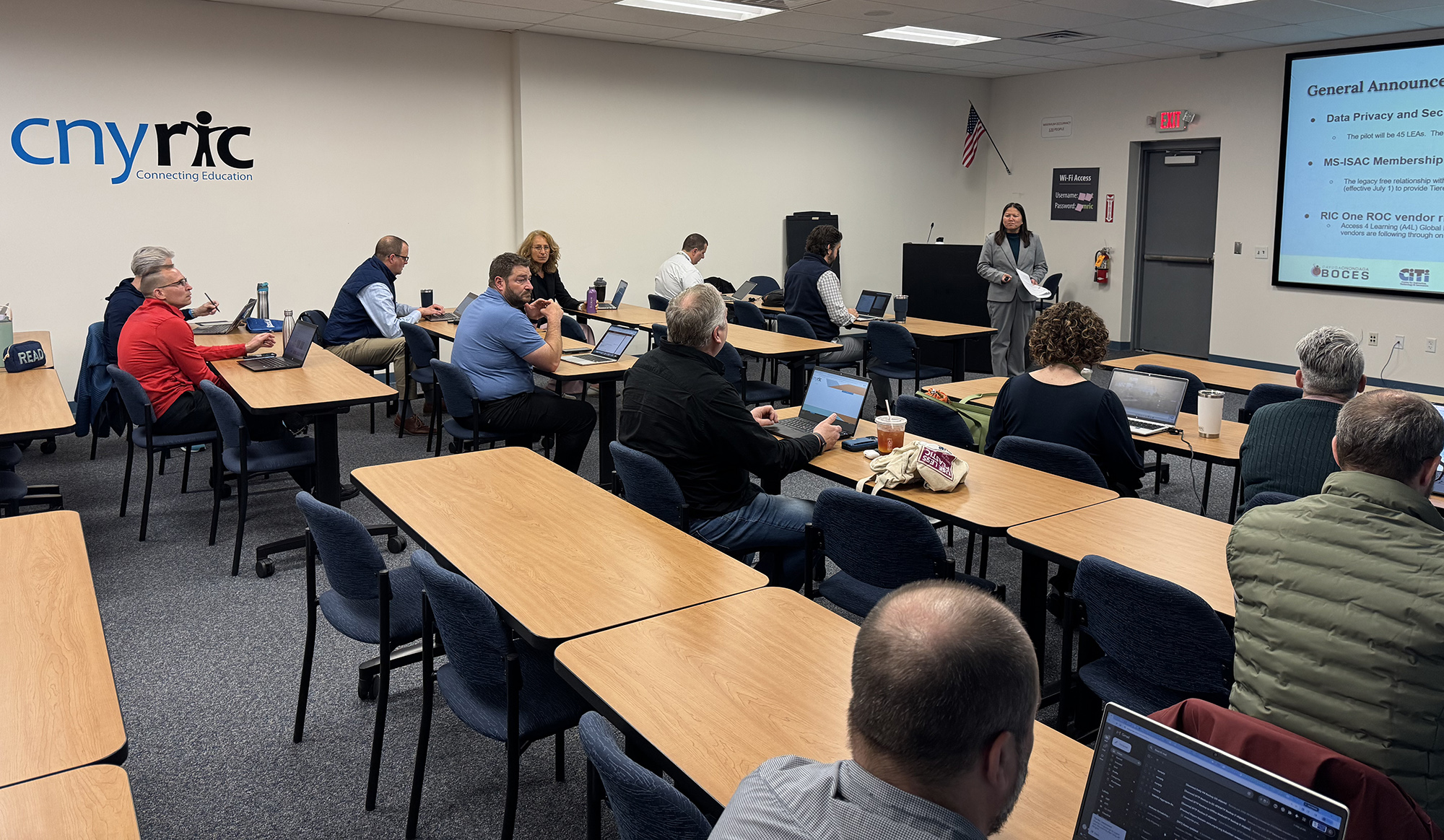
In May, the CNYRIC hosted its final Technology Collaborative of the year, welcoming directors of technology from around the region (both virtually and in person) to talk shop regarding critical updates, potential new products and services, and hot topics in educational technology. We’d like to share a few highlights from those conversations!
Wide Area Network Updates
The CNYRIC recently sent out a survey to districts ahead of the upcoming wide area network (WAN) bidding process, a three-year cycle that will begin anew later this year. A clear collaboration among district leadership was evident in the responses, and facilitated a lot of great conversation among CNYRIC officials at their meeting that followed. Another meeting is scheduled for August, which will see the CNYRIC further hone options based on district feedback, and where it's expected to start presenting final options to districts. CNYRIC Assistant Director of Information Technology, Josh Becker, also walked attendees through the bidding process timeline to help ensure that everyone stays on the same page.
Facilitated Discussion: The Criticality of Uptime
This discussion was kicked off by Josh Becker sharing a document that challenged districts to consider how they’d address a list of scenarios, such as, “Our HVAC is down; how long do we keep students in the building if there isn’t a quick fix?” or “Our transportation systems are down; how can we continue to bus kids to and from school effectively?” The handy checklist was intended to give districts a framework for their strategies to approach these scenarios, and minimize the chances of being caught flat-footed in an incident. It also echoes a lot of the conversations that the CNYRIC’s Data Privacy and Security Service team has been having with districts regarding the necessity to have disaster recovery plans, so that the playbook is already laid out in the event of an incident.
Hot Topics: Proxy Pages That Circumvent Restrictions
This conversation revolved around a somewhat recent trend by which students have been able to take advantage of scripting services that logistically can/should not be blocked by districts (such as Google Apps Scripts or Amazon Web Services) to run proxy web pages that allow them access to social media inside of schools, which is largely blocked/prohibited by most districts in 2026. The group discussed the challenges of keeping up with these pop-up pages without help, though a couple of folks mentioned that services such as Aristotle and Lightspeed have active solutions in place to mitigate the workaround.
Model Schools Update
The CNYRIC’s Supervisor of Data Analysis Services Lori DeForest was on hand to review end-of-year reporting deadlines for districts and data protection officers (DPOs). Lori remarked that there are several upcoming user groups for both districts and BOCES scheduled to help DPOs navigate these deadlines more effectively, and also reminded attendees that CNYRIC data coordinators are on hand to conduct data audits as needed. Also from the Educational Services Department, Database Administrator Amanda Hardin discussed data exports for special education program service records among these year-end reporting activities.
Wide Area Network Updates
The CNYRIC recently sent out a survey to districts ahead of the upcoming wide area network (WAN) bidding process, a three-year cycle that will begin anew later this year. A clear collaboration among district leadership was evident in the responses, and facilitated a lot of great conversation among CNYRIC officials at their meeting that followed. Another meeting is scheduled for August, which will see the CNYRIC further hone options based on district feedback, and where it's expected to start presenting final options to districts. CNYRIC Assistant Director of Information Technology, Josh Becker, also walked attendees through the bidding process timeline to help ensure that everyone stays on the same page.
Facilitated Discussion: The Criticality of Uptime
This discussion was kicked off by Josh Becker sharing a document that challenged districts to consider how they’d address a list of scenarios, such as, “Our HVAC is down; how long do we keep students in the building if there isn’t a quick fix?” or “Our transportation systems are down; how can we continue to bus kids to and from school effectively?” The handy checklist was intended to give districts a framework for their strategies to approach these scenarios, and minimize the chances of being caught flat-footed in an incident. It also echoes a lot of the conversations that the CNYRIC’s Data Privacy and Security Service team has been having with districts regarding the necessity to have disaster recovery plans, so that the playbook is already laid out in the event of an incident.
Hot Topics: Proxy Pages That Circumvent Restrictions
This conversation revolved around a somewhat recent trend by which students have been able to take advantage of scripting services that logistically can/should not be blocked by districts (such as Google Apps Scripts or Amazon Web Services) to run proxy web pages that allow them access to social media inside of schools, which is largely blocked/prohibited by most districts in 2026. The group discussed the challenges of keeping up with these pop-up pages without help, though a couple of folks mentioned that services such as Aristotle and Lightspeed have active solutions in place to mitigate the workaround.
Model Schools Update
The CNYRIC’s Supervisor of Data Analysis Services Lori DeForest was on hand to review end-of-year reporting deadlines for districts and data protection officers (DPOs). Lori remarked that there are several upcoming user groups for both districts and BOCES scheduled to help DPOs navigate these deadlines more effectively, and also reminded attendees that CNYRIC data coordinators are on hand to conduct data audits as needed. Also from the Educational Services Department, Database Administrator Amanda Hardin discussed data exports for special education program service records among these year-end reporting activities.